

Mercedes-Benzis a German manufacturer of automobiles, buses, coaches, and trucks. It is currently a division of the parent company, Daimler AG (formerly DaimlerChrysler AG), after previously being owned by Daimler-Benz. Mercedes-Benz has its origins in Karl Benz's creation of the first gasoline-powered automobile in January 1886, and by Gottlieb Daimler and engineer Wilhelm Maybach's conversion of a carriage by the addition of a petrol engine the same year. The Mercedes automobile was first marketed in 1901 by Daimler Motoren Gesellschaft. The first Mercedes-Benz brand name vehicles were produced in 1926, following the merger of Karl Benz's and Gottlieb Daimler's companies into the Daimler-Benz company. Mercedes-Benz has introduced many technological and safety innovations that have become common in other vehicles several years later.
Quality
Since its inception, Mercedes-Benz had a reputation for its quality and durability. Objective measures looking at passenger vehicles such as J.D. Power surveys demonstrated a downturn in reputation in this area in the late 1990s and early 2000s. By mid-2005, Mercedes temporarily returned to the industry average for initial quality, a measure of problems after the first 90 days of ownership, according to J.D. Power. In J.D. Power's Initial Quality Study for the first quarter of 2007, Mercedes showed dramatic improvement by climbing from 25th to 5th place, surpassing quality leader Toyota and earning several awards for its models. For 2008, Mercedes-Benz's initial quality rating improved by yet another mark, now in fourth place. On top of this accolade, it also received the Platinum Plant Quality Award for its Mercedes’ Sindelfingen, Germany assembly plant. As of 2009, Consumer Reports of the United States has changed their reliability ratings for several Mercedes-Benz vehicles to "average," and recommending the E-Class and the S-Class.

Motorsport
Since its inception, Mercedes-Benz had a reputation for its quality and durability. Objective measures looking at passenger vehicles such as J.D. Power surveys demonstrated a downturn in reputation in this area in the late 1990s and early 2000s. By mid-2005, Mercedes temporarily returned to the industry average for initial quality, a measure of problems after the first 90 days of ownership, according to J.D. Power. In J.D. Power's Initial Quality Study for the first quarter of 2007, Mercedes showed dramatic improvement by climbing from 25th to 5th place, surpassing quality leader Toyota and earning several awards for its models. For 2008, Mercedes-Benz's initial quality rating improved by yet another mark, now in fourth place. On top of this accolade, it also received the Platinum Plant Quality Award for its Mercedes’ Sindelfingen, Germany assembly plant. As of 2009, Consumer Reports of the United States has changed their reliability ratings for several Mercedes-Benz vehicles to "average," and recommending the E-Class and the S-Class.
Motorsport
The two companies which were merged to form the Mercedes-Benz brand in 1926 had both already enjoyed success in the new sport of motor racing throughout their separate histories- both had entries in the very first automobile race Paris to Rouen 1894. This has continued, and throughout its long history, the company has been involved in a range of motorsport activities, including sports car racing and rallying. On several occasions Mercedes-Benz has withdrawn completely from motorsport for a significant period, notably in the late 1930s and after the 1955 Le Mans disaster, where a Mercedes-Benz 300SLR collided with another car and killed more than eighty spectators. Although there was some activity in the intervening years, it was not until 1987 that Mercedes-Benz returned to front line competition, returning to Le Mans, DTM, and F-1 sports car racing with Sauber.
The 1990s saw Mercedes-Benz purchase engine builder Ilmor (now Mercedes-Benz High Performance Engines), and campaign IndyCars under the USAC/CART rules, eventually winning the 1994 Indianapolis 500 and 1994 CART IndyCar World Series Championship with Al Unser, Jr. at the wheel. The 90s also saw the return of Mercedes-Benz to GT racing, and the Mercedes-Benz CLK GTR, both of which took the company to new heights by dominating the FIA's GT1 class.
Mercedes-Benz is currently active in three forms of motorsport, Formula Three, DTM and Formula One. In Formula One, the company part owns Team McLaren and has supplied the team with engines engineered by Ilmor since 1995. This partnership has brought success, including Drivers Championships for Mika Häkkinen in 1998 and 1999 and for Lewis Hamilton in 2008, as well as a Constructors Championship in 1998. The collaboration with McLaren has been extended into the production of roadgoing cars such as the Mercedes-Benz SLR McLaren.
Business alliances (Studebaker-Packard Corporation)
In 1958 Mercedes-Benz entered into a distribution agreement with the Studebaker-Packard Corporation of South Bend, Indiana (USA), makers of Studebaker and Packard brand automobiles. Under the deal, Studebaker would allow Mercedes-Benz access to their U.S. dealer network, handle shipments of vehicles to those dealers, and in return receive compensation for each car sold. Studebaker also was permitted to use the German automaker’s name in its advertisements, which stressed Studebaker's quality over quantity.
When Studebaker entered into informal discussions with Franco-American automaker Facel Vega about offering their Facel Vega Excellence model in the United States, Mercedes-Benz objected to the proposal. Studebaker, which needed Mercedes-Benz distribution payments to help stem heavy losses, dropped further action on the plan.
Mercedes-Benz maintained an office within the Studebaker works in South Bend from 1958 to 1963 when Studebaker's U.S. operations ceased. Many U.S Studebaker dealers converted to Mercedes-Benz dealerships at that time. When Studebaker closed its Canadian operation and left the automobile business in 1966, remaining Studebaker dealers had the option to convert their dealerships to Mercedes-Benz dealership agreements.
Models
Mercedes-Benz range today
Mercedes-Benz has a full range of passenger, light commercial and heavy commercial equipment. Production is on a global basis. The Smart brand of city cars has also been part of the Mercedes-Benz Group since 1994.
Passenger cars

Pope Benedict XVI in a Mercedes-Benz Popemobile in São Paulo, Brazil
The following passenger vehicles were in production in 2009:
- A-Class Hatchback
- B-Class Sports Tourer/Hatchback
- C-Class Sedan, Sports Coupe & Wagon
- CL-Class Coupe
- CLK-Class Coupe & Cabriolet
- CLS-Class "4-door Coupe"
- CLC-Class luxury compact car
- E-Class Sedan, Coupe & Wagon
- G-Class Cross-country vehicle
- GL-Class SUV
- GLK-Class SUV
- M-Class SUV
- R-Class Minivan
- S-Class Sedan
- SL-Class Roadster
- SLK-Class Roadster
- SLR-McLaren High Performance Coupe & Roadster
Significant car models produced
- 1928: SSK legendary racing car
- 1930: 770 "Grosser Mercedes" state and ceremonial car
- 1934: 500 K
- 1936: 260 D World's first diesel production car
- 1936: 170
- 1938: W195 Speed Record-breaker
- 1951: Mercedes-Benz 300, knownly as "Adenauer Mercedes"
- 1953: "Ponton" Models
- 1954: 300SL "Gullwing"
- 1959: "Fintail" Models
- 1960: 220SE Cabriolet
- 1963: 600 "Grand Mercedes"
- 1963: 230SL "Pagoda"
- 1965: Mercedes-Benz S-Class
- 1966: 300SEL 6.3
- 1968: W114 "New generation" compact cars
- 1969: C111 experimental vehicle
- 1972: Mercedes-Benz W107 350SL
- 1974: 450SEL 6.9
- 1974: 240D
- 1976: 300D
- 1979: 500SEL and G-Class
- 1983: 190E 2.3-16
- 1986: First 'E-Class'
- 1991: 600SEL
- 1993: First 'C-Class'
- 1995: First 'Joint Mercedes-Benz & AMG' (C43 AMG)
- 1995: Mercedes-Benz SL73 AMG, 7.3L V12 (biggest engine ever put in a Mercedes-Benz)
- 1996: Mercedes-Benz Renntech E7.4RS
- 1997: Mercedes-Benz M-Class
- 1998: Mercedes-Benz CLK
- 2004: Mercedes-Benz SLR McLaren
- 2004: Mercedes-Benz CLS
- 2007: E320, GL320 Bluetec, ML320 Bluetec, R320 Bluetec
McLaren cars

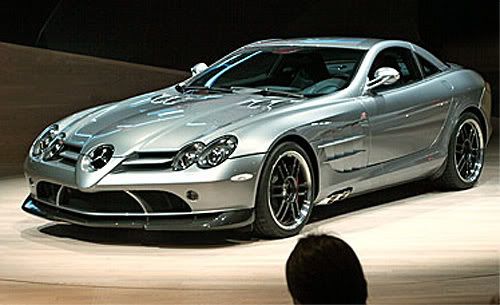
A silver SLR McLaren on display at the 2006 European Motor Show in Brussels.
Mercedes-Benz has also produced a sports car with McLaren Cars, an extension of the collaboration by which Mercedes engines are used by the Team McLaren-MercedesFormula One racing team, which is part owned by Mercedes. The 2003 Mercedes-Benz SLR McLaren has a carbon fiber body with a 5.4l V8 supercharged engine. This is the same block as featured in SL55 AMG and the CLS55 AMG, though modified to give 460 kW (630 PS; 620 hp) and 780 N·m (575 ft·lb) of torque. The SLR has a maximum speed of 337 kilometres per hour (209 mph) and costs approximately US$500,000. Due to European pedestrian-protection regulations, McLaren has decided to cease production of the SLR in 2009.
The most recent new joint-venture model, expected to reach production, is the mid-engine P8 sports car. Based around a unique carbon fibermonocoque, manufactured by McLaren, the P8 was originally predicted to receive the new naturally aspirated 6.2L V8 from Mercedes-AMG, but insiders[citation needed] now say that the engine will be modified for the car and will probably be twin-turbocharged to produce in excess of 600 bhp (450 kW). The car is still in development, but likely to reach production to go on sale in early 2008, and have a price tag less than that of the SLR.
Car nomenclature
In 1994 (starting with the 1994 models), the traditional nomenclature of Mercedes-Benz vehicles changed. Since the early days of the company the name would be in the form of 500E where the engine displacement made up the first three numbers and the last letter(s) represented the type of engine and/or chassis; for example: "E" for fuel injection ("Einspritzung" in German), "D" for Diesel, "L" for long wheelbase etc.
In 1994, this was altered so that the prefix reflected the model ("class", German "Klasse", in Mercedes-Benz terminology) and a number the displacement. The suffix was retained in some cases, for example "L" for long wheelbase, and "CDI" for Diesel (CDI = Common-rail Direct Injection). Thus, the 500E in the example above became the E500 ("E-Klasse", 5 liters displacement). It should also be noted that while in the past the model number generally accurately reflected the actual engine displacement, this is currently not always the case—for example the E200 CDI and E220 CDI actually both have a 2.2 liter/litre displacement, and the C240 actually has a 2.6 liter/litre engine.
Electric vehicles
At the 2007 Frankfurt motor show, Mercedes-Benz showed seven hybrid models, including the F700 concept car which combined hybrid drive with the innovative DiesOtto engine. In 2009, the S400 hybrid sedan is scheduled to go on sale.
On the other hand, Mercedes-Benz says it will have a demonstration fleet of practical, if small, electric vehicles on the road in two to three years, from 2008.


No comments:
Post a Comment